
How many solar panels do I need? For the average Hawaii home, the answer is smaller than most people expect: roughly 10 to 13 modern panels can cover typical household electricity use, although many island homes install closer to 20 once batteries, electric vehicles, and air conditioning enter the picture. The exact number depends on three things you can measure: how many kilowatt-hours your home uses, how much sun your roof receives, and the wattage of the panels you choose. This guide walks through that math with current Hawaii numbers so you can sanity-check any quote. ProVision Solar has sized systems for homes on Oahu, Maui, and the Big Island since opening in Hilo in 1998, and the method below is how our designers start every proposal.

How Many Solar Panels Do I Need for an Average Hawaii Home?
The average Hawaii home needs about 10 to 13 solar panels to cover its yearly electricity use with today’s 440-watt panels. That estimate starts with consumption. Hawaii households used an average of 495 kilowatt-hours per month in 2024, compared with 863 kWh nationally, per the U.S. Energy Information Administration. Hawaii homes use less power than mainland homes partly because the climate is mild and partly because electricity is so expensive, with the same EIA data putting the average Hawaii residential price at 42.86 cents per kilowatt-hour.
Panel count follows a simple formula published by EnergySage: annual electricity usage divided by your production ratio, divided by panel wattage. The production ratio is how many kilowatt-hours a system produces each year for every watt installed, and EnergySage notes it usually falls between 1.1 and 1.6 across the United States. Sunny leeward Hawaii roofs sit toward the higher end of that range, while cloudier windward neighborhoods sit lower.
A Worked Example: How Many Solar Panels Do I Need at 500 kWh a Month?
Here is how the math works for a Hawaii home using 500 kWh per month, close to the state average:
- Annual usage: 500 kWh per month times 12 equals 6,000 kWh per year
- Production ratio: a sunny Kona or Kihei roof might reach about 1.4, while a rainy Hilo roof might land closer to 1.1
- System size: 6,000 divided by 1.4 is about 4,300 watts on the sunny roof, or about 5,450 watts on the rainy one
- Panel count: divided by 440 watts per panel, that is roughly 10 panels on the sunny roof and 13 panels on the rainy roof
Your own electric bill replaces the 500 kWh figure. Find the kWh total on each monthly Hawaiian Electric statement, add up the last 12 months, and you have the single most important input in the calculation.
Why Do Many Hawaii Homes Install More Panels Than the Average?
Many Hawaii homes install more panels than average usage suggests because they plan for batteries, electric vehicles, and future loads rather than today’s bill alone. The average residential system size in Hawaii is 8.69 kilowatts in 2026, per EnergySage marketplace data, which works out to about 20 panels at 440 watts. That is nearly double the panel count an average 495 kWh household needs, and the gap has real reasons behind it:
- Electric vehicles: an EV driven 10,000 miles a year can add roughly 2,500 to 3,500 kWh of annual demand, depending on the model
- Air conditioning: homes adding split systems or central air in warmer leeward areas can see usage climb sharply in summer
- Electrification: replacing a gas water heater, range, or dryer with electric versions moves that energy onto the solar system
- Household changes: working from home, multigenerational living, or a new ohana unit all raise daily consumption
Because Hawaii closed traditional net metering to new customers in 2015, exporting surplus power earns far less than using it yourself. That makes accurate sizing important in both directions. Too small leaves you buying expensive grid power, and too large can mean producing energy you cannot use or store. Every Residential Solar Installation from ProVision Solar begins with 12 months of your actual usage plus a conversation about what is likely to change over the next five years.
How Do Your Island, Roof, and Panel Choice Change the Count?
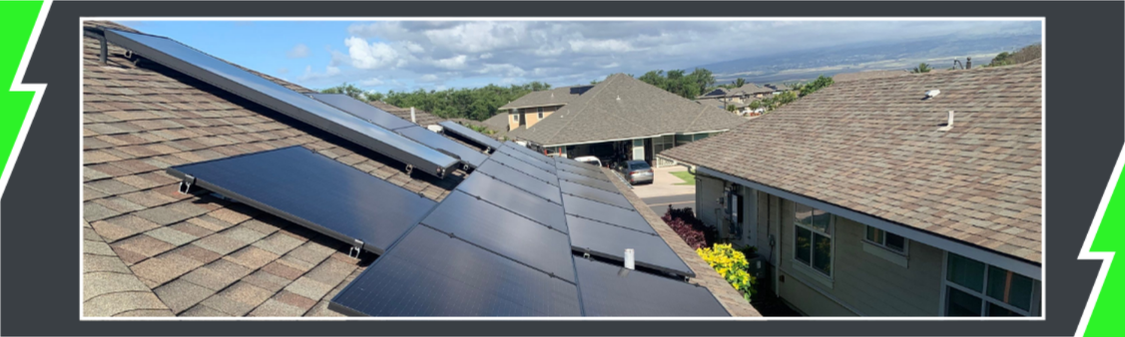
Your island microclimate, roof layout, and panel wattage can move the panel count by several panels in either direction. Hawaii’s sun is strong statewide, but a south-facing roof in sunny West Hawaii produces noticeably more per panel than a partly shaded roof in a windward valley that catches afternoon showers. Good designers account for this with site-specific production modeling instead of a single statewide number.
Roof orientation and shading matter nearly as much as location. South and west exposures generally produce the most, east-facing arrays favor morning output, and shade from trees, neighboring buildings, or rooftop equipment cuts production from every panel it touches. Available roof space sets a hard ceiling: if a roof only fits 14 panels, higher-wattage modules become the way to reach a larger system size.
Rising panel wattage keeps pushing the count down. About 97% of solar panels fall in the 400-watt-and-up range in 2026, per the same EnergySage sizing guide, so each panel on your roof does more work than older models did. ProVision Solar selects its Photovoltaic Modules with Hawaii’s strong sun and coastal conditions in mind, which helps a tight island roof deliver the output a household actually needs.
Should You Size Your Solar Panels Around a Battery?
Yes, most Hawaii homes should size solar panels with a battery in mind, because a battery changes when panel output gets used and backup goals can change how much output you need. A battery does not raise your total energy use. Instead, it captures midday production that would otherwise be exported for little credit and releases it in the evening, when Hawaii homes use the most power. A single Tesla Powerwall 3 stores 13.5 kilowatt-hours, per Tesla, enough to carry a large share of a typical household’s evening and overnight use.
Backup planning is where the panel count can grow. During a multi-day outage, the panels must run the home during daylight and refill the battery before sunset. On a cloudy day, a system sized only for average annual usage may fall short of doing both. Homes that prioritize resilience during hurricane season often add a few panels beyond the bill-matching number so the battery recharges reliably. Our Tesla Powerwall Installation team designs the array and battery together so the two are matched from day one.
Rather skip the math? Schedule a free solar assessment and our designers will model your roof against your real usage.
Frequently Asked Questions
How many solar panels does it take to power a house in Hawaii?
Most average Hawaii homes need about 10 to 13 panels rated around 440 watts to cover yearly electricity use of roughly 500 kWh per month. Homes with electric vehicles, air conditioning, or battery backup goals often need closer to 20 panels.
How do I calculate the number of solar panels my home needs?
Add up your electricity use in kWh over the last 12 months, divide by your roof’s production ratio, then divide by the panel wattage. For example, 6,000 kWh divided by 1.4 and then by 440 watts equals about 10 panels.
Do I need more solar panels if I add a Tesla Powerwall?
Not always. A battery stores midday solar for evening use without increasing total consumption. Homes that want reliable backup during multi-day outages, however, often add a few panels so the system can power the house and fully recharge the battery each day.
Does living in a rainy part of Hawaii mean I need more panels?
Usually, yes. Cloudier windward areas such as Hilo produce less energy per panel over a year than sunny leeward areas like Kona or Kihei, so the same household may need two or three more panels on a windward roof to cover the same usage.
Get a Panel Count Built Around Your Home
How many solar panels do I need is ultimately a question about your household, not a statewide average. Your 12-month usage, your roof, your island’s weather, and your plans for a battery or EV all move the number. ProVision Solar has designed systems across Oahu, Maui, and the Big Island since 1998 and handles permitting and Hawaii incentive paperwork for every client. Contact Us Today for a free, usage-based system design.
Information pertaining to laws, regulations, or incentives is accurate at the time of writing this content. However, regulations and systems can change at anytime.